Lagos Govt To Demolish Landmark Beach Resort To Give Way For Coastal Highway Construction Of Lagos-Calabar Road Project.
By: Onome Ose
When Lagos state authorities notified the Paul Onwuanibe, business mogul in late March that he had seven days to leave his multimillion-dollar beach resort so it could be torn down, he thought it was an April Fools’ Day hoax come early.
Onwuanibe was told in a government letter that his Landmark Beach resort a top-tier destination visited, he says, by about a million local and foreign visitors last year had to be removed as it “falls within the right of way” of a planned 700-kilometer (435-mile) coastal highway designed to link the former capital city to Calabar, a port city near the border with Cameroon.
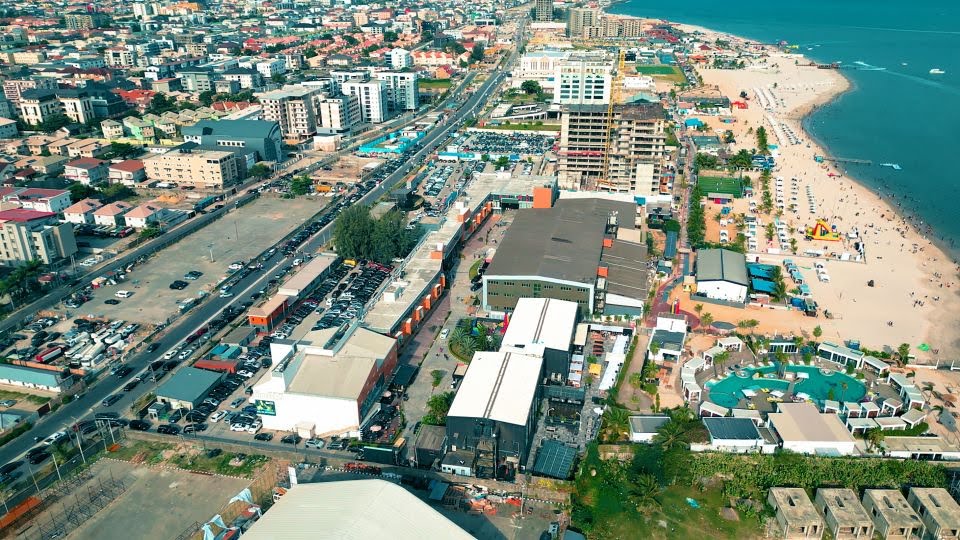
As the Lagos government is set to demolish a portion of the Landmark Beach Resort to give way for the coastal highway construction of Lagos-Calabar road project.
Onwuanibe, receiving seven day’s notice of removal of property felt it was an April fool that had come early.
In a letter to the business mogul Paul Onwuanibe dated March 19, 2024, and signed by the Deputy Director (Development Matters Department) TplShomolu O., on behalf of the permanent secretary of the Ministry of Physical Planning and Urban Development.
According to the letter, the state government noted that the sections of the property billed for demolition such as the Beach Resort, Kids and Bay Arena, Members Area, Lagos Beach Club fall within the Right of Way of the proposed road project by 50 meters.
The beach resort which is valued at over $200 million, according to Onwuanibe, the Landmark site is home to over 80 businesses and provides more than 4,000 direct jobs.
It also generates over 2 billion naira ($1.5 million) in annual tax revenue.
Recall that the Lagos state government had written the company in two different national newspapers on the demolition.
“Following the publications of Friday 15th and Saturday 16th March, 2024, in the two national newspapers, for the constriction of 103km stretch of the 700km Lagos-Calabar coastal highway by the Federal Ministry of Works, in collaboration with Lagos State Government, I am to inform you that your property falls within the Right of Way Alignment of the project by 50 meters.
“Consequently, the affected portion shall be removed in overriding public interest, to pave way for the road construction project from seven (7) days of serving this notice.
“In view of the above, I am to request you to forward all documents supporting your ownership of the property to the Permanent Secretary, Lands Bureau, Block 13 and 14, The Secretariat, Alausa, Ikeja.’’
“One was amazement, second was concern and the third one was, ‘is this real or is this an April Fools’ (Day prank in) advance?’”
Onwuanibe told newsmen, he had obtained the land in 2007 before the plans for the coastal highway were drawn up, and felt a mix of emotions after receiving the demolition order, which also urged him to file compensation claims.
Onwuanibe leads Landmark Group, a real estate developer and a key player in Nigeria’s tourism and hospitality industries.
The group’s leisure beach, listed among Nigeria’s best seven beaches in 2023 by the Lonely Planet travel guide, is a lucrative part of the 13-hectare mixed-use Landmark site along the Atlantic Ocean beachfront in Lagos’s affluent Victoria Island area.
The beach resort and other sections of the Landmark site on the coastal right of way are billed to be pulled down, a government notice seen by our team.
Approval for the new coastal road was given on February 27 by the federal authorities, according to presidential aide Temitope Ajayi. He said that the superhighway, “when completed, will enter the world record books among iconic coastal routes like the Wild Atlantic Highway in Ireland and the Pacific Coastal Highway in the United States.”
The first part of the 1.06 trillion naira ($841 million-plus) highway will be built in Victoria Island. The superhighway will run through a total of nine coastal states in Nigeria, Ajayi added, and will have “five lanes on each side of the dual carriageway and a train track in the middle,” as well as spurs linking up with northern Nigeria.
Environmentalists say that, while the coastal road project would bolster the economy, it also poses environmental problems.
“It’s undeniable that the road construction will bring about significant impacts such as the destruction of wetlands, forests, and various habitats,” said Lagos-based water and environment consultant Similade Adeodun. “Activities like sand filling and dredging along the coastal areas also raise concerns,” he said.
Meanwhile, the Lagos State Ministry of Physical Planning and Urban Development for comment on the coastal right of way and the consultation process involved.
Valued at over $200 million, according to Onwuanibe, the Landmark site is home to over 80 businesses and provides more than 4,000 direct jobs. It also generates over 2 billion naira ($1.5 million) in annual tax revenue, the company said.
Onwuanibe, born in the United Kingdom, says he “shut down” his investments abroad in 2007 to focus on ventures in Africa due to the continent’s economic prospects.
He commended the planned coastal project for “connecting vital regions of the country” but feared it came at a steep cost for tourism in Lagos and posed a threat to foreign direct investment into the country if Landmark Beach is eventually torn down.
“People who bring in money to make cities like this effective will be very concerned (with the proposed demolition of the beach resort). It will pose a huge threat to inward investment into the state and, most importantly, pose a threat to people who are already in the state trying to do things,” Onwuanibe said.
“Demolition of the beach would be an enormous loss, with millions of dollars of borrowed money already spent on developing the resort.
“We’ve spent between $80 and $90 million developing this ecosystem and one-third of that was spent on the beach. So, all that, which we are still paying loans on, will disappear,” he said.
Onwuanibe said foreign and local investors in Landmark Group were now threatening to pull out if the beach resort, which includes a mini golf course, a beach soccer field as well as a volleyball and basketball court, is removed.
“Without the beach, the entire ecosystem is at risk and is severely damaged,” he said, adding: “I have had widespread panic calls from my international and local investors as well as local debt providers threatening to pull the plug as they think this is material to our survival as a business.”
Lagos state, Nigeria’s economic nerve center, has been on the hunt for foreign investment as federal authorities battle to revamp the country’s economy in the face of challenges such as growing public and private debt, high inflation, and a sharp decline in the local currency.
However, “policy and regulatory inconsistency” and “poor stakeholders’ consultation” have limited foreign investment into Nigeria, according to a local think-tank, the Nigerian Economic Summit Group.
Environment consultant Adeodun is urging authorities to conduct thorough environmental and social impact assessments before tearing down coastal businesses for the superhighway.
“For Landmark Beach, which already generates significant revenue from eco-tourism, the government should explore robust measures to preserve the beach or consider alternative routes with fewer economic and ecological consequences,” Adeodun said.
“I understand that the original right of way for the road did not pass through Landmark Beach… Perhaps, revisiting the routes to ensure minimal environmental damage and preserve local businesses should be strongly considered,” he added.
For Onwuanibe, the coastal highway, once rethought, should serve as a blessing for thriving businesses situated along the coast rather than a curse.
“The first thing would be to do a proper study and proper consultation with the businesses that are most affected along it. It’s a long-term project, so it requires more in-depth analysis,” he said, adding that he was hopeful that discussions with the government can produce a “win-win solution.”
“The second thing is to make sure that this (highway) is an advantage to those businesses and homes and all that socioeconomic activity, rather than a disadvantage,” he added.
Paul Onwuanibe is an African business magnate. He is best known as the MD/CEO of Landmark Group an African-focused real estate and serviced office company having over 500 companies as clients with offices in five continents. In 2010, he acquired over 150,000sqm of land on the Atlantic coastline, pivoting Landmark from a serviced office operator to a mixed-used developer. Onwuanibe has since positioned Landmark as the fastest growing business, leisure, and lifestyle destination on the West African Coastline.
Under Onwuanibe’s leadership, Landmark has raised more than $100 million in development funding and has grown to a PWC endorsed enterprise valuation of more than $300 million. Onwuanibe is a well-regarded African business leader, with a deep and passionate interest in real estate in Africa.
Onwuanibe is driven by the goal to create the first pan African real estate and service organisation themed on his live, work and play philosophy.
He is driven by the goal to create the first pan African real estate and service organisation themed on his live, work and play philosophy.
Onwuanibe was born in Paddington, London to George Onwuanibe. and Dorothy Onwuanibe.
About The Author