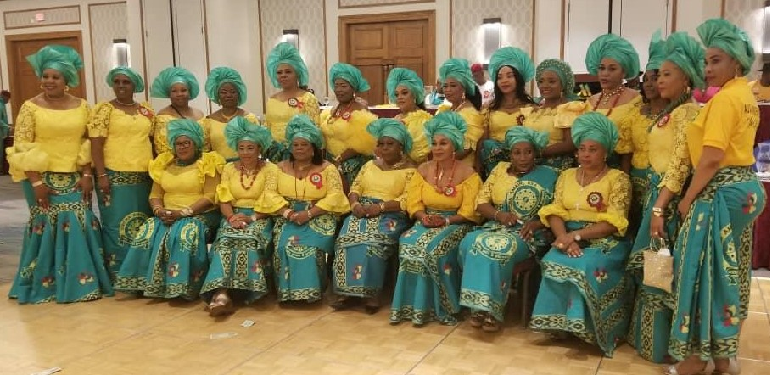
Umuada/Umumgboto Most Powerful And Respected Daughters In Igboland
By: Nwanma Ogidi
The Umuada/Umumgboto in Igboland are peacemakers, speak the truth, and preach love in families. They are caring and peacemakers, and their impartial nature earns them respect.
Umuada/Umumgboto are peacemakers and character molders, and it’s an institution that protects women’s dignity, the sanctity of marriage, and family life.
“Umuada/Umuokpu or Umumgboto as they are being called are daughters married to other places, whatever occasion that is done in the community, they still extend an invitation to them. Umuada/Umuokpu or Umumgboto there is always a provision for them in whatever is shared in the community.
Waka About Africa findings noticed that both Umuokpu and Umuada or Umumgboto are very powerful to the extent that when a man dies and if they do not come for the burial ceremonies, it means that there is an unresolved issue between them or the community with the bereaved family. And they must be appeased to attend the burial. Also, when a fellow woman dies in her husband’s home, no matter the distance, both Umuokpu and Umuada must travel to the place and show their presence until she is buried.
They will be given their rights and nobody jokes with that. For instance, if one fails to provide Umuada with their rights in a burial ceremony and they go home angry, the implication is that the burial is incomplete”.
“This means that Umuada or Umumgboto are still daughters in Igboland even though they have been married out, if they stay with us, there will be no space for us in the family.
“Another important thing the Umuada or Umumgboto is whenever there is a dispute in the family, they are invited to settle the matter and speak the truth. “They are given so much respect because they stand for truth and uprightness.
The Umuada/Umumgboto in Igbo cultural group is one of the most organized, peaceful and endowed women groups in Igboland Nigeria. They are defined as the most powerful daughters in Igbo culture. Umuada means native daughters of common male ancestors or “daughters of the soil’. Ada is a collective term for all first daughters and is formed from two Igbo words while Umuada is a generic plural word that conveys the sense of many…
In a typical Igbo community, Umuada/Umuokpu or Umumgboto as the case may be, who are women from the community but married to other places are formidable Umuada are well respected in Igboland.
The opinions of Umuada/Umuokpu or Umumgboto on traditional issues where sought, are highly regarded. They are always invited to intervene to resolve family, kindred and community issues in their maiden communities/families, even protracted ones. They wield enormous powers.
The Umuada/Umuokpu or Umumgboto are dreaded by women married into their families and even their brothers also dread them. It is an age-long unique administrative institution in Igboland, whose opinions and actions are usually not ignored, they are seen and respected as peacemakers.
“Umuada/Umuokpu or Umumgboto are being respected being accorded Umuada flows from the fact that they speak and stand for truth. This is the reason they are always invited to intervene and resolve disputes”.
The Umuada/Umuokpu or Umumgboto is a traditional sociopolitical kin group in the south-eastern region of Nigeria and is comprised of both the first daughter and other daughters of each family, called the Umumgboto. It is given the utmost respect and granted ‘male’ privileges and responsibilities.
It analyses the question, ‘What role does the Umuada/Umuokpu or Umumgboto play in de-escalating conflict and upholding peace in south-eastern Nigerian communities’
They have historically served as a forum for women to voice their concerns, needs and desires. They are a vital pillar of the community, acting as arbitration and de-escalation forces and performing cultural roles men cannot.
Furthermore working closely with patriarchal institutions and occupying key cultural functions have allowed the Umuada/Umuokpu or Umumgboto to adapt to changing times and maintain a strong level of agency and respect in the community.
Waka About Africa findings recommend the Umuada as a model of peacebuilding to women across Igboland and beyond. They interrogate, the peace-building activities of a subgroup of women in the south-eastern region of Nigeria (Igboland), called the Umuada/Umuokpu or Umumgboto, a traditional sociopolitical institution consisting of the daughters of a community.
Highly respected, the Umuada hold various roles as agents of peace-building and reconciliation and collectively as the vanguard of sociopolitical development. An institution that dates back to pre-colonial times, it has reinvented itself and continues to have relevance in modern Nigeria
The Umuada\Umumgboto, however, assume the role of peacebuilders from a position of strength, which they derive from their unique sociopolitical role and high status in Igbo society.
Apart from their general role as advisers, women have their council of female elders, parallel to the council of male elders. In critical situations, both councils could meet together for deliberation and consultation. Women may demonstrate their political pressure through their meetings, which may be inter- or intra-lineage in structure and usually operative under the aegis of the most senior married women.
In the southeastern communities under study, women’s groups actively engage in structured lineage subgroups and religious subgroups. Members hold regular meetings. Historically, these segregated meetings have enabled women to articulate their issues and protect the group interest, and have provided an avenue via which to discuss communal and economic issues, such as market rules, the prices of goods, and other market processes Until the present day, any discrimination, especially against fellow women, has been frowned upon; even in spaces where it was pronounced, such as in the domestic or the community space, women would engage whether invited to or not.
Waka About Africa noted that during the pre-colonial times, women played key roles in the sociopolitical structure of the region. From the nineteenth century into the colonial era, women collectively organized through non-violent means to resist acts of discrimination, oppression and violence.
The Aba women’s resistance to colonialism in 1929 is a testament to women’s strong organizational skills and political constituency in traditional Igbo society called (semi-structured interviews (SSIs), women known as peacebuilders. The Aba women’s protest was the first documented case of women’s resistance to imperialism in colonial Nigeria.
What do Umuada/Umuokpu or Umumgboto represent…
Umuada represents one of the veritable tools in the government of traditional Igbo setting. Before the advent of the warrant chiefs, county council, or Igwe as the head of a community, Umuada and Nze na Ozo society was the only government of the time. Therefore, Umuada (daughters of the land) has been as old as Ndi Igbo and has been in the vanguard of socio-cultural and socio-political development in the community. African culture is mostly male-dominated, as is the culture of many native nations worldwide.
However, the paternalistic propensity of African culture, especially the Igbo culture, does not indicate the subjugation of women. On the contrary, women in traditional Igbo societies are a force in political, legal, and social issues.
Long before the colonists arrived in Africa, and even during and after colonialism, women were a powerful part of the Igbo society. Igbo women have many forums designed to present and protect their interests. The most important of these female forums is called, Umuada/Umuokpu or Umumgboto.
Igbo women have many forums designed to present and protect their interests.
The most important of these female forums is Umuada/Umuokpu or Umumgboto…it is special attachment, uncommon love and interest that Umuada usually show on issues affecting their birth family earned them special respect in that family. Umuada plays key roles in ensuring their male siblings get married for the continuity of the family lineage as well as command the full respect of their wives.
Umuada/Umuokpu or Umumgboto diversify their traditional role of unifying their communities to tackle the prevailing insecurity challenges in Nigeria, particularly in Igboland.
Umuada are respected in Igboland even in our various communities because of their impartial nature.
They are not easily influenced by material gifts on issues of importance, Umuada is like that everywhere in Igboland, unlike their male folk who can easily thwart justice over a bottle of beer or other common inducements.
In some cases “Men who are on the side of justice are rare in our clans now. They can easily be influenced, unlike the Umuada who do not thwart their judgment carelessly. They are mostly on the side of justice.
“Most times, when a conflict reaches a stalemate amongst most clans in Igboland, Umuada are invited for settlement because of their impartial nature”.
“Umumgboto are specially respected in Igboland which could be traced to the Igbo tradition of ‘Onye aghala nwanneya’ (be your brother’s keeper). Ndigbo believes that marriage does not deprive a daughter of her birthright, hence, during payment of bride price, the groom is usually made to understand that the bride is not for sale.
The caring and homely attitude of Umuada\ Umumgboto earned them the special place they occupy in the hearts of their male siblings, saying that the special recognition Umuada has in their ancestral family made their opinions and verdicts highly revered.
“No reasonable man in Igboland will challenge or flout the decision of Umuada as doing so is akin to challenging the gods. It is of note that the tradition of placing high value on Umuada\ Umumgboto has survived many centuries and has come to stay.
Outstanding Roles of “Umuada\Umungboto…
Waka About Africa noticed that what Abia women did in 1929; they sent the colonial masters packing.
“Umuada\Umungboto are powerful in Igboland”. “The Umuada help to re-certify or re-invigorate that value for our tradition. It may seem archaic but we believe it is a warranty that depicts our value before the advent of the white man. Respecting the Umuada is the beginning of wisdom.
“For us Igbo, our custom and tradition are held in high esteem. Our value for tradition in real life is very important. The Umuada help to recertify the value of our tradition; development or modernization cannot stop or change the important roles they play in Igboland. Some may see it as olden days practice while others may see it as archaic, but no matter how archaic it may seem, we believe it is a warranty that depicts our value before the advent of the white man and it cannot be changed because it will amount to destroying Igboland without them.”
“Umuada\Umungboto are a formidable and coordinated institution that cannot be bought with money and nobody can defy the authorities of Umuada as they would always maintain their stand.
“Umuada are the mothers of the people. They mold people’s characters. Someone can hate his father but can’t hate his mother because of the existing bond between them as such love continues to grow right from birth to old age. Umuadas are recognized as peacemakers. They don’t involve themselves in land issues as land problem divides families.
“It is the function of the Umuada to keep vigil if a relation dies. They are the people to ensure that everybody comes and if you fail to come, they will not come when it happens to you.
“Umuada are a formidable group that instills discipline and sanity in the minds of their people. So, nobody defies the authority of the Umuada\Umungboto, rather they can defy the authority of men.
“They are the mothers of men and daughters of men. If women rise against you, you are gone. They are resolved, united and not looking for material things, not interested in land grabbing or chieftaincy tussles. They maintain their stand, you cannot buy them with money,”
“Umuada is an administrative agency in traditional Igbo societies, It comprises both married and unmarried daughters from the same village.
“Umuada have a restricted area of influence in communal matters. As an institution, it primarily seeks to protect the woman’s dignity and sanctity of both marriage and family life. They preside over residual issues such as abortion, infidelity, husband battering, husband snatching and enforcement of widowhood practices, and especially investigate cases where a widow is suspected of having a hand in the death of her husband among others.
“These are issues considered beneath men’s attention and properly within the purview of women because they have greater insights into them. Women accused of any of the abominable conducts above feel free to confess to fellow women who in any case, know how to probe and prod the accused, than men. Yet, in the spirit of protecting their dignity, Umuada\Umungboto may impose a sanction on an accused person without disclosing the sordid details of what transpired to the men folk to avoid stigmatization.
“Umuada\Umungboto wield special jurisdiction to impose binding settlement where the village head is unable to settle a matter about family life. Ordinarily, such matters may include wife battering, dereliction in providing for the family, or desertion.”
Waka About Africa’s further findings show that they wield more expertise in female psychology and can tease out more information from their fellow women, they can understand the motivation behind certain female conducts and can impose sanctions on their likes without being accused of having ulterior motives since gay practice was unknown to traditional Igbo societies.
“In times past, the decision of the Umuada was binding but in contemporary times, accused persons may invoke their constitutional rights to fair hearing to circumvent such decisions. Again, it should be stressed that the Umuada institution is more pronounced.
“Umuada\Umungboto are powerful and respected in Igboland because they are not partial, any matter or issue they judge, adjudicate, discuss and take a decision on, is never faulted.
They play a major role particularly when a married woman in their community is becoming so stubborn and destructive to the community. They will all gather and discuss the issue of the woman and take a decision on her. They can send such a woman or any other woman trying to destroy their community packing without the husband’s authority. They play very strong roles as the custodians of culture and tradition, peacemakers in their communities and role models as well as act as checks on the women married into their communities.
About The Author